FAIR PLAY


FAIR PLAY, Lost Thought at the Old Fitz, 6.21 March 2026. Photography by Robert Miniter
In UK playwright Ella Road’s 2021 two-hander, Fair Play, Ann (Rachel Crossan) and Sophie (Elodie Westhoff) are two high school girls who meet as promising track athletes. Sophie is White, upper middle class, and Home Counties. Ann’s father is Nigerian, but she’s working class, and (shudder) Hounslow. It’s a prickly foundation for a friendship, particularly as they are both 800m runners and on a parallel upward trajectory.
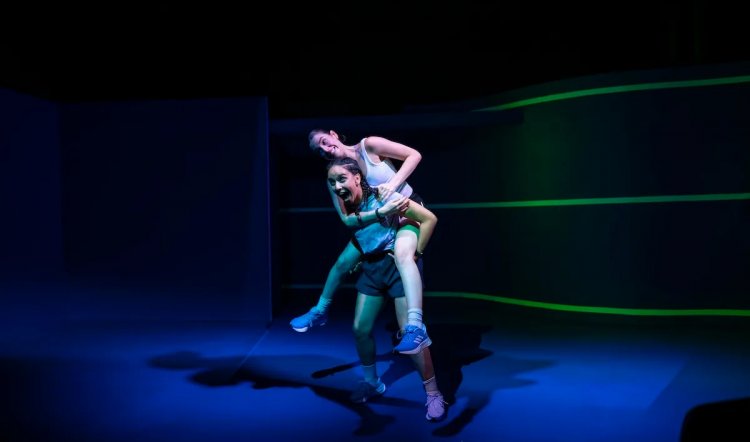
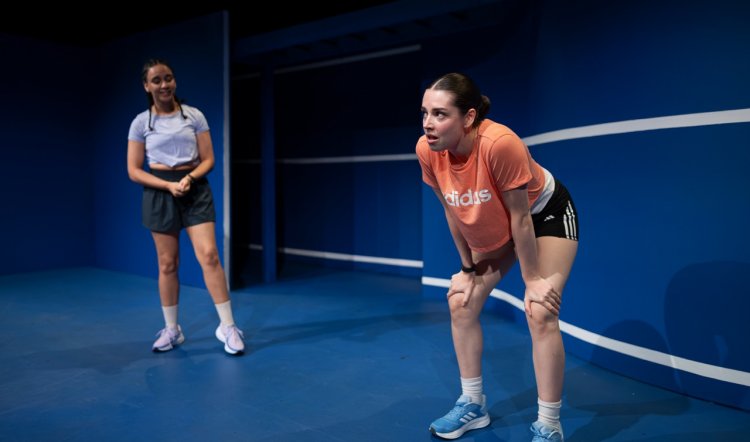
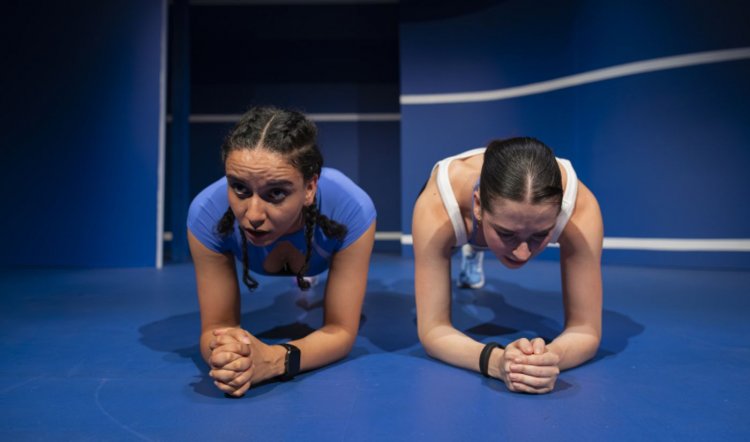
As they slog through their training, warm-ups, warm-downs, gym sessions, and school homework – while trading verbals and, almost accidentally getting to know each other – the same happens for the audience. Their performances are sustained, intelligent and virtually flawless as they vividly convey the explosive nature of youthful emotions. These are made even more intense by the demands of total immersion in the charged atmosphere of elite athletics (director Emma Whitehead).
As well as revelatory dialogue that switches minute by minute from teen banality to maturely thoughtful, the relentless physicality of their days is illustrated through stage-wide, dizzying choreography (Cassidy McDermott Smith) on a set of abstract blue track-with white lines (designer Kate Beere). As well, the extremes of the arcane world of PBs, splits, medalling, Euros, Worlds, and the ultimate goal of the Olympics that consume Ann and Sophie are further escalated through EJ Zielinski’s impressionistic lighting, video projections by Aron Murray, and a mind-bending soundscape from Mitchell Brown and Osibi Akerejola.
For anyone thinking, at this point, that 100 minutes about a couple of schoolgirl track stars couldn’t possibly be of interest, please do think again. Ella Road was Olivier-nominated for her first play, The Phlebotomist; this is her second and also successful. Other credits include the TV comedy Ten Percent (UK version of Call My Agent) and episodes of the Netflix hit Black Mirror. In other words, Fair Play is to track and field what Mamma Mia! is to Greek tourism.
A close friendship blossoms between Ann and Sophie, despite the obstacles thrown at them by society and circumstance. Ann starts out in op shop gear and the restrictions of church on Sunday and her mum’s watchful eye, while Sophie is clad in Adidas three-stripes and her parents are free with their largesse. Sophie is Received Pronunciation and posh, while Ann is glottal stops and belligerence. Then, however, as Ann’s unflagging determination pays dividends, other hurdles are presented: envy and jealousy are almost inevitable; excruciating demands are placed on both from coaches, administrative poobahs, social media, and peers.
By the time the audience has become fully immersed in their rarified world, and got to know the pair as three-dimensional and likeable young women, a sudden twist is shocking as Ann is thrown to the wolves of political correctness, racism, sexism and public prejudice. At the same time, Sophie’s immediate bewilderment and indecision are all too human and plausible. She vacillates between supporting her friend or listening to the wise old White men who command athletics, and her agony is palpable.
Fair Play is at once a comedy, a drama and also one of the most persuasive political polemics we might encounter so far this century. Without preempting or placing a spoiler alert, it’s on a topic that has caused more furore, pain and devastation than anything that’s faced women since the struggle for universal suffrage. Most will likely leave the theatre knowing more, knowing better, and feeling a bit sheepish as well as enlightened.
Then there’s what happens to Sophie, and that’s a story of rampant capitalism, ruthless ambition (not necessarily hers), and the scrapheap that lies at the end of the track when dreams give way to reality. An electrifying and unexpected entertainment: see it!