GOODNIGHT SWEET PRINCE

GOOD NIGHT SWEET PRINCE, Old Fitz Theatre, 31 July-15 August 2026. Photography by Campbell Parsons
The first thing to know about this new play on Shakespeare’s Hamlet is that its creators - actors Raj Labade and Jack Twelvetree, and director Liesel Badorrek - do not follow Chekhov’s dictum about a gun on stage in Act 1 (should be fired in Act 2). Instead of the firearm is a piano accordion that occupies a central position in Keerthi Subramanyam’s ethereally beautiful and mysterious set, but doesn't get played, ever. Or perhaps this is the ghost of Sport for Jove’s superb 2013 production where a piano accordion had a playing role?!
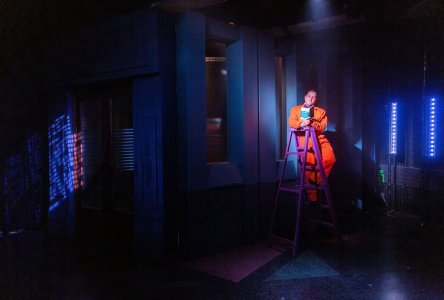
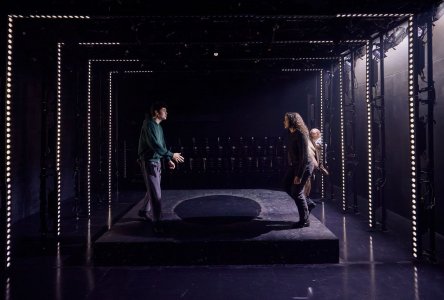
In truth, the overall setting says more about Hamlet’s state of mind than we’re accustomed to seeing on a stage and the effect, with chairs and books suspended, upside down, from the ceiling and a chandelier hanging in as an Elizabethan disco ball, is fascinating. All this and more, together with Verity Hampson’s breathtaking, pinpoint-cued lighting and Ross Johnston’s quietly ominous, constant, distant battle sound design, is mesmeric, even before the prince asks his fabled question. This Elsinore is not a happy place, but paradoxically, it’s good to be there.
Partly it’s because the play has been fragmented and condensed into 70 minutes for two actors, with one playing Hamlet and his ghostly father, and the other playing everyone else, with others left out for purists and pedants to grouse about. Partly because Labade and Twelvetree take turns to be or not to be Hamlet in the roles and, on Tuesday, August 4, it was Labade’s night as the grieving prince. In the opening scene, he also sees and becomes his murdered father via a vocal tic and light: the dead king is shadow, his son is dazzling bright.
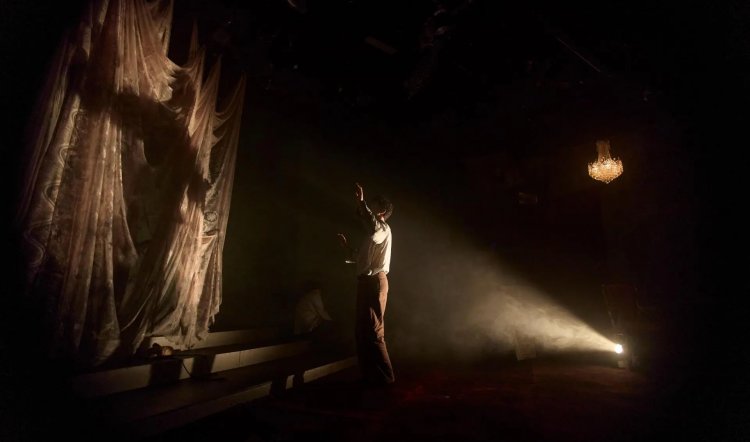
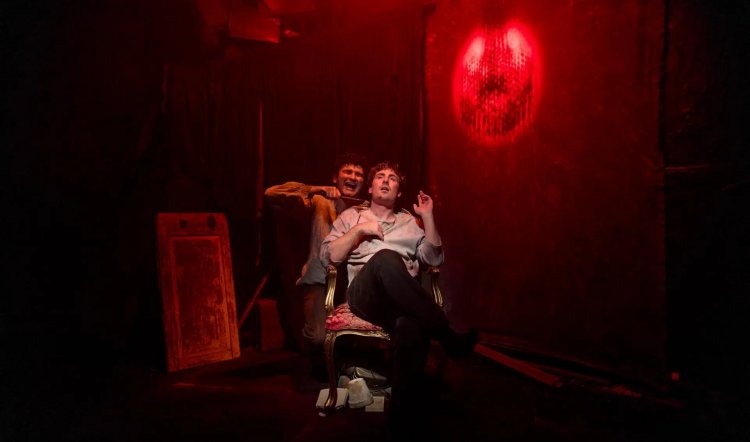
For a play titled Hamlet, there is a lot about other people, and often he is an observer of others, himself and events. Here, he is a participant – in his grief (he did love Ophelia, he says, as her drowned body is carried by); in his rage (his uncle not only murdered the king but married the widow, with unseemly haste); and in his youthful despair. Labade conveys with sweet subtlety that this is a young Hamlet, one who brandishes a dagger but is too emotionally overwrought to do much with it.
The new king, meanwhile, is supremely pleased with himself as he prances like a fancy man in the sparkling light of the chandelier. Twelvetree slips in and out of his varied roles with easy conviction. In particular, there is deep poignancy in the fleeting circle of the stage as he carries the empty, silvery fabric length that is Ophelia.
Between the two men – as friends, enemies, courtiers – there are tangible and credible relationships, but it’s as the two young men: the prince and his friend Horatio that heartstrings are plucked. Hamlet’s bewilderment at the visions of his dead father, and Horatio’s confusion at his friend and master disintegrating into dangerous shards of humanity are profoundly moving. Many young men, and those who love them, would recognise the parallels in what confronts them in 2026.
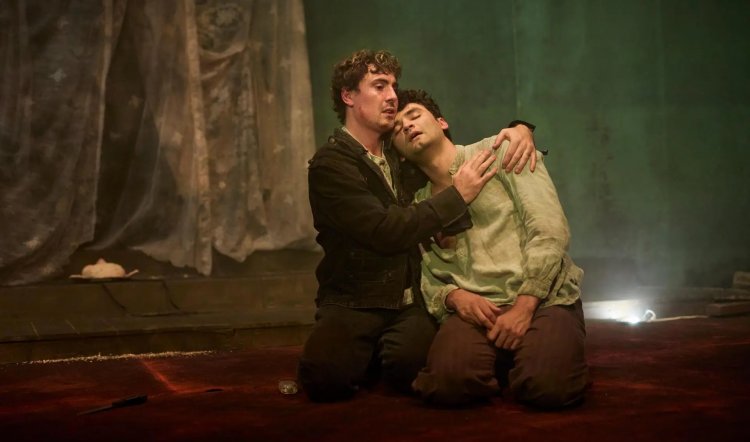
Elsinore in the eyes of Hamlet and Horatio is a corrupt, unkind, cold place. Its physical dangers are real, but disillusion is possibly more shocking. Badorrek’s direction is clear and unsentimental, and it makes the prince Hamlet more of today than most. As the two inhabit the tatty phantasmagoria that was once a palace, they prowl or sit, crouch and sometimes are afraid, sometimes perplexed, and never secure in themselves or safe in their surroundings.
Both Labade and Twelvetree are excellent in these roles (haven’t seen the reverse), and in the world created by the ace creative team, 70 minutes pass almost too quickly, but leave echoes and resonance for hours afterward. Recommended without reservation.