THE DROVER'S WIFE - the opera

THE DROVER’S WIFE, Opera Australia and QPAC with Oombarra Productions, at Joan Sutherland Theatre, Sydney Opera House. 7-15 August 2026. Photography by Carlita Sari
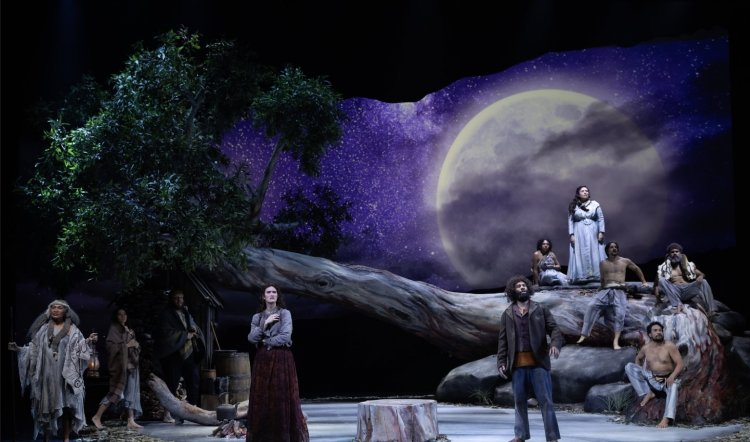
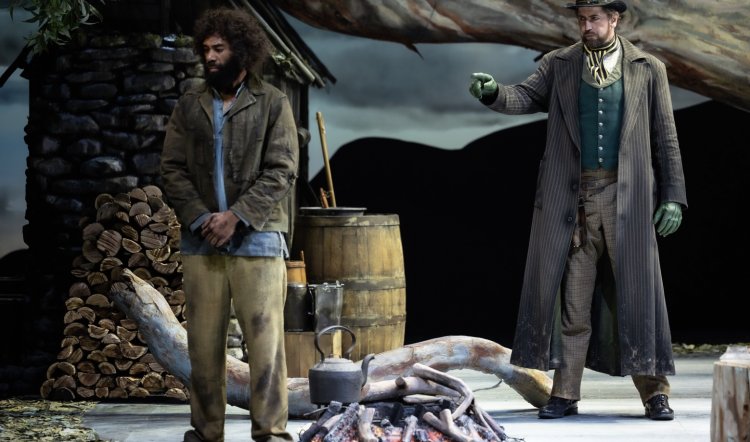
The opening of The Drover’s Wife is a heart-pumping, mind-expanding experience. The curtain rises on High Country NSW. It’s bleak and beautiful with a silhouetted mountain range behind a massive snow gum growing out of massive rocks, and long ago bent to the prevailing wind. It forms a sheltering arm over a clearing. Nestled beneath its leafy crown is a rough shack. There’s a fireplace in the clearing, seating logs on either side. It’s home for Molly Johnson (Nina Korbe) and her family, and she will sweep that clearing often. Leah Purcell’s adaptations, first for the stage, then a novel, the screen and now, with composer George Palmer, is a fully realised opera of two parts and 2.5 hours, with interval.
Defying the soughing, indifferent winds, Aboriginal warriors and women enter, clad in eddies of ghostly, scribbly bark-decorated robes (choreographer Yolande Brown). The air fills with the rhythms of song, stamping and clap sticks. This is one of the most famous opera stages in the world, yet tonight it’s reclaimed as hallowed ground by First Nations. And through the exquisite, apposite work of set designer Isabel Hudson, costume designer Tess Schofield and lighting designer Karen Norris, the audience is instantly transported in place and time.
Henry Lawson’s story was first published in The Bulletin, “the bushman’s bible”, in 1892. What they expected from their magazine was encapsulated in its logo, “Australia for the White Man.” The Lawson story has been part of Purcell’s life since it was a favourite read-aloud by her mother to an imaginative kid. But the kid grew up and saw that not only did many Australians still yearn for a White country (currently called “monoculture), but also that many men, of all races, still did – or wanted to – behave like the men of Lawson’s story: contemptuously violent at best, opportunistic rapists at worst.
As a Blak woman of the 21st century, Purcell has now taken her own long overdue liberties with the sacred symbol of White literature. She has colonised the colonials, turned their favourite tropes upside down; she confounds the status quo, yet she honours the story that first inspired her. It’s a unique and gracious achievement; astounding in its generosity, and she directs the whole with thrilling confidence.
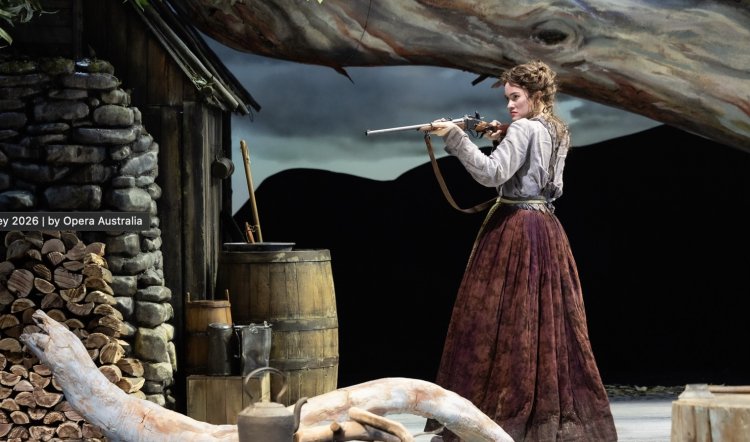
In contrast and rapport, Palmer’s score, played with energy and precision by the Opera Australia Orchestra under Tahu Matheson, eschews cliches, instead drawing sound pictures and motifs that support and enhance the characters and stories. Palmer and Purcell collaborated on the libretto, and it distills Lawson’s tale to its essence while enriching it with depths he could not imagine. The anonymous wife is now named – Molly Johnson – and seizes agency through that. The black snake that terrorises her and the children over one endless night becomes the human snakes who constantly prey on her. Woodwinds and a lone clarinet underpin yet another lonely pregnancy, yet another baby to bury.
Nina Korbe’s powerful, golden soprano makes a glorious Molly, rifle in hand, love for her children outweighing the ice in her heart. She is matched by a narrative twist in reinventing the ne’er-do-well Black drifter Yadaka. In the role, tenor Marcus Corowa takes the false accusations heaped on him and, via an unearthly harp, fashions a dignified, heroic man who would melt Molly’s frozen soul.
The passage of time is seen in the mountain range, above which a sliver of sky is revealed as a visual trick when it widens into varying states, from impending storm, to nights of infinite stars, to crisp pink mornings, and soft pink nights (video: Craig Wilkinson). As time passes, Molly’s eldest son Danny grows from impetuous boy to manhood and a totemic figure throughout. Nick Smith movingly captures the lad and his growing devotion to Yadaka – unconsciously seeking to emulate him in manliness and decency. Danny’s love for his mother and determination to protect the family are the light in the darkness of the snakes that beset them.
And now, one of those snakes is the Drover himself, whose absences are no longer the necessity of a man providing for his family but something less admirable. What he might be is embodied in the presence of the Peddler (a frightening Shane Lowrencev), the Drover’s greasy mate McNealy (Barry Ryan), and the trigger-happy trooper and a couple of right bastards (Elias Wilson, Simon Meadows and Zoy Frangos).
Observing from an earlier time, John Longmuir is Molly’s Scottish dad Jock, and his love Black Mary (Shauntai Abdul-Rahman). The latter is a towering spirit, vocally and physically, and with Ginny May (dancer Jeanette Fabila), a crucial revelation for Molly.
I’d like to think that, like the Moshinsky Rigoletto, this new piece will be in the repertoire in 30+ years, because The Drover’s Wife is a brilliant achievement for the ages in every way. Never to be forgotten.