THE ELEVATOR

THE ELEVATOR, Ensemble Theatre, 18 September-18 October 2026. Photography by Prudence Upton
No-nonsense, working-class janitor Ollie (Di Adams) could be speaking to a large proportion of the audience, male and female, when she comments to uppity CEO Margot (Leeanna Walsman),“I think we have different ideas of what success looks like.” It’s a thought that runs subliminally through The Elevator, Eloise Snape’s second play, and one that’s a long way on from her successful 2023 debut work, Pony (at Griffin).
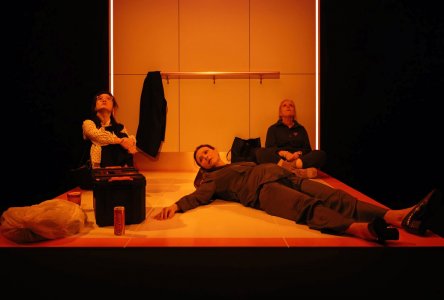
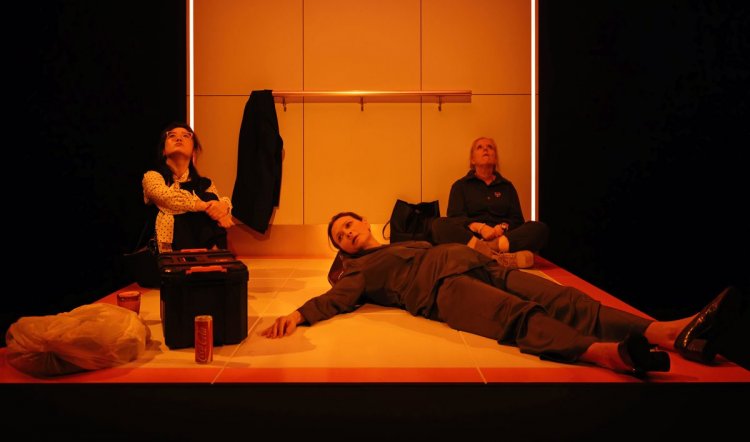
Margot, her crisis comms executive Alison (Shirong Wu), and Ollie are stuck in a lift – elevator – somewhere between the ground and 48th floors. Designed and lit by Kelsey Lee, the set is exactly what a luxe CBD office tower lift looks like: a deceptively peachy atmosphere in a clearly defined box. It’s roomy enough for the usual 15 persons, but when three women are trapped, and one is 24 hours postpartum and throws up in her handbag, it’s suddenly not.
The lift is a product of Margot’s company – an AI tech behemoth. She is just six months into the CEO role after the classic parachute-in to clean up the mess left by her predecessor, a BSD* sex pest. There are no buttons to press in the lift; instead, a passenger must request a floor number. If “please” or “thank you” isn’t included, the lift doesn’t move. It’s remarkably passive-aggressive. It’s also voiced by the sex pest under the acronym TAURUS (Talkback Activated Universally Responsive User System, wouldn’t you know, and actually Johnny Nasser).
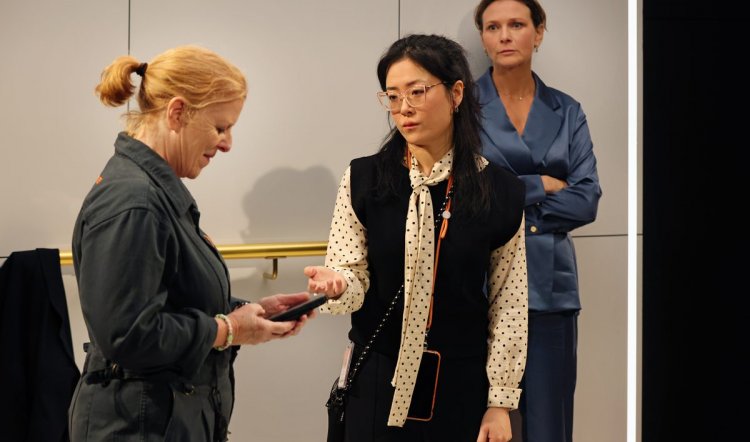
Margot is in a hurry to reach the 48th floor where she is due to front a press conference. She must fix the latest corporate mess: their star product, a driverless car, has run amok and seriously injured a pedestrian. Alison is polishing the media release while Margot replaces her unhelpfully honest language with euphemisms. Alison’s nervous laughter and Margot’s superior crankiness fill the rapidly overheating lift.
Despite the confined space, the gulf between Ollie and the two corporates is vast. Their signifying clothing (costume designer Keerthi Subramanyam) is the visible difference: Ollie’s work boots and overalls are a world away from Margot’s subtle silk and Alison’s smart black and white, but it’s also attitude. The janitor is virtually invisible to the businesswomen – until they think she might be useful. For her part, Ollie’s disdain for their behaviour and priorities is more than obvious. When Margot snaps at Ollie that she is “not a person of consequence,” the collective gasp from the audience rattles the auditorium.
Meanwhile, occasional but increasingly ominous groans from the lift well add to the growing tension in the elevator car (composer and sound designer Daniel Herten). Playwright Eloise Snape has fashioned a sly trap for an audience: the snappy jokes and one-liners, and comical situations that lull the chuckler into feeling they know where this is going. Then, before it can be fully grasped, the direction and tone change to something darker and much more serious. Much more serious.
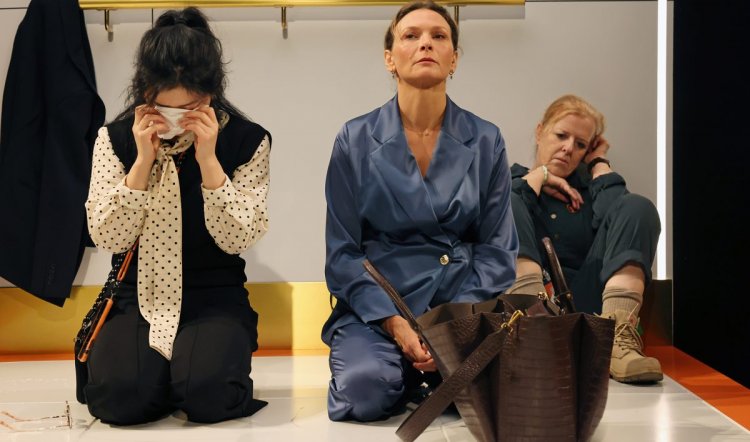
Director Anthea Williams deftly choreographs the minimal opportunities for movement and changes of focus in the lift space. At the same time, the rising and ebbing tides of emotion in and around the trio are authentic and instantly recognisable for the women watching their predicament play out. Swirling around as time passes and agitation grows are the shadows of the everyday: environmental crises, corporate immorality, truth, lies, the continuing battle for respect of women in the workplace – no matter at which level they find themselves.
And if the absence of mobile reception isn’t bad enough, when new mother Margot starts leaking, the nervous laughter (women) and disconcerted wriggling (men) herald a whole new response to life’s problems. The performances from the three women are intelligent and dynamic. The play itself is over-ambitious in the full range of its many socio-political targets, but that’s not a criticism. Better to reach for the stars than the low bar. Some of the twists and turns of the final fifteen minutes (of 90) are far-fetched, but because they are twisting and turning, the result is enthralling. Recommended.
*Big Swinging Dick – Wall Street argot for a successful man.