-c750x442.jpeg)
DIAL M FOR MURDER

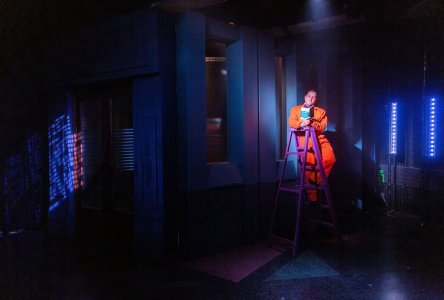
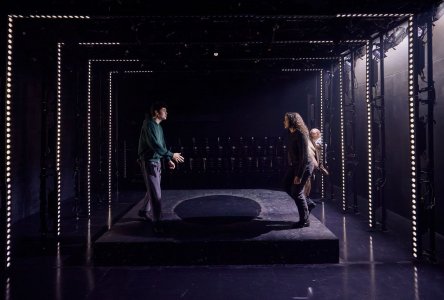
DIAL M FOR MURDER, Ensemble Theatre, 28 November 2025-11 January 2026. Photography by Phil Erbacher: above - Anna Samson and Madeleine Jones; below - Garth Holcombe, Anna Samson and Moraleda; David Soncin and Garth Holcombe
The most unlikely element of Frederick Knott’s 1952 play (and 1954 movie) is that the leading man, Tony Wendice (Garth Holcombe), is a former British professional tennis player. Really? Is this a comedy? No, he’s retired and reliant on his socialite wife’s money. She, Margot (Anna Samson), is having a secret affair with Maxine (Madeleine Jones), an American crime writer. Except Tony knows and has hatched a plot to have Margot murdered. Part revenge, but mostly inheritance of her money, are his motives.
In 1952 and 1954, however, Maxine was Max, and it was Jeffrey Hatcher’s 2020 adaptation that switched genders. If it was a piquant idea in 2020, it actually makes sense in 2025. And not because of the current obsession with everything queer, but because it’s so much easier on the eye to see two women in a company of six rather than five blokes and a lone female.
As it is, the twists and turns of the plot(s) are enough to make Agatha Christie’s head spin, never mind seeing Anna Samson in a whole new light. (She’s currently on ABC TV and iView as the latest detective in the Paradise franchise, and forever unravelling unlikely, convoluted plots in a picturesque location.)
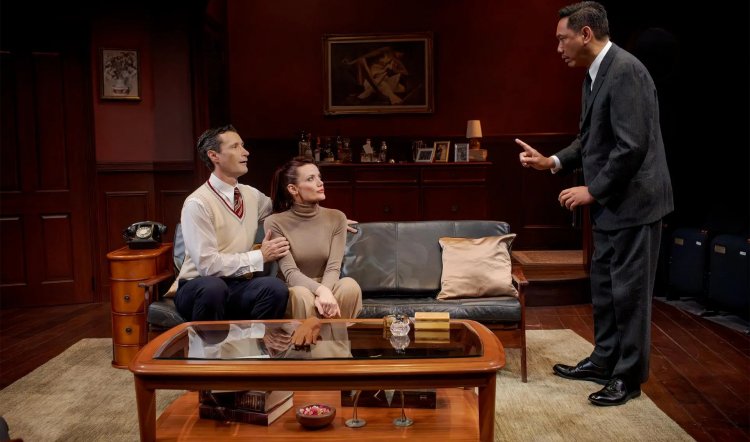
In Dial M, the location is the Wendices’ smart London flat, where they wear smart clothes and unknowingly dance a dance of secret schemes. Think a hired hit man, blackmail letters, a handy pair of scissors, £5000 and bucketsful of suspicion, red herrings and bewilderment. (The latter sloshing around the audience as tension and nervous laughter mount.)
Director Mark Kilmurry orchestrates cast and complications with a deft touch. It’s not easy to build an atmosphere of danger and fright on a stage, but with set and costume designer Nick Fry and lighting designer Matt Cox, the physical is at first comfortably upper middle class, then slides into shadows and foreboding, so when a small time hood (David Soncin) turns up to do away with Margot, it’s genuinely alarming. So too is Madeline Picard’s soundscape as it conjures Hitchcock and assorted nerve tinglers. And dialect coach Linda Nicholls-Gidley has performed wonders with a range of English accents from up and down the social scale – not as easy as it sounds, and the cast is pitch perfect.
Pomp and circumstance and comic relief arrive in the second half in the form of Inspector Hubbard (Kenneth Moraleda). Scotland Yard’s finest poo-poos the notion of the perfect crime as he seeks out one of his theorised five motives for murder. The audience bumbles along in his wake as suspects tumble like skittles. Will X get away with it? Oh, so is it Y? Or maybe Z…?
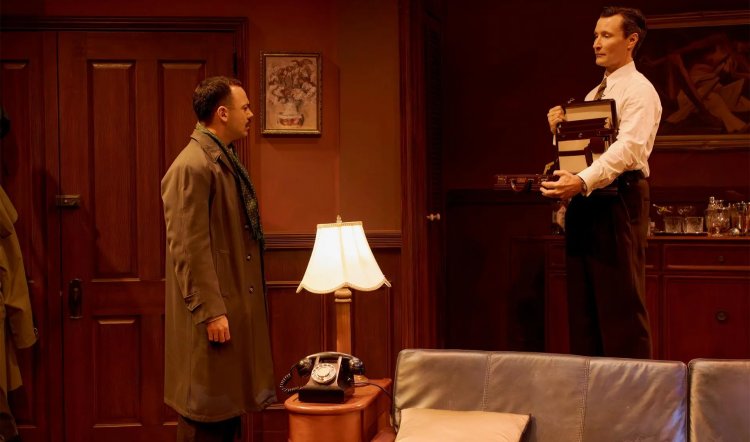
Making the unexpected and the unlikely even more entertaining are the performances of other members of the company. Garth Holcombe is charming, yet oozes gradually revealed grievance and entitlement. While alive, David Soncin is a shockingly malevolent crim, then a plausible corpse.
Stars of the show, however, are Madeleine Jones as a fully realised, deliciously credible Maxine, and Anna Samson, whose subtlety and comic timing are a delight. Even as the show teeters between Cluedo, Clouseau and Gaslight, it maintains a powerful grip on the audience with gasps and titters punctuating the two hours. Dial M is as entertaining now as it was 70+ years ago, with or without the perfect crime.