

HARLOTS

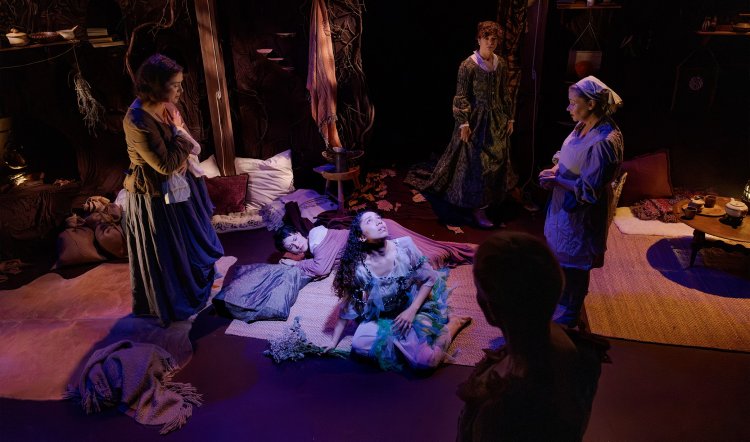
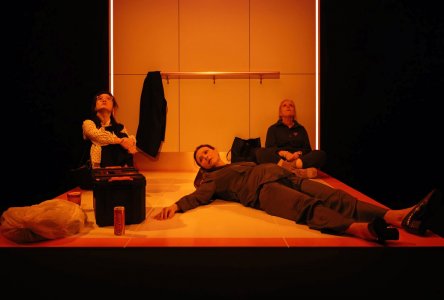
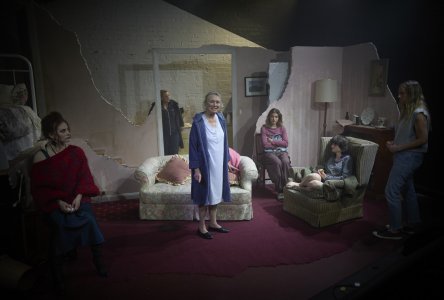
HARLOTS, New Ghosts Theatre Company at the Old Fitz, 23 August - 6 September 2026. Photography by Phil Erbacher
In 1966, Tom Stoppard plucked Rosencrantz and Guildenstern from obscurity in the pages of Hamlet and placed the pair front and centre. Hamlet, hitherto their boss, was reduced to a bit player and his girlfriend Ophelia had a walk-on – no lines. As we know, Rosencrantz and Guildenstern Are Dead was wildly successful, and immortalised them. Ophelia still ended up drowned.
Now, in 2026, Emma Wright has also riffed off Shakespeare, but this time with far more ambition, and with political and social outcomes that are impossible to ignore. The title signals much: for centuries, women – in law, literature, life, and death – must be virgin or mother to be acceptable in polite society. More than that, they must be dutiful, obedient, and demure. Anything else invited the terms harlot, strumpet, or hussy bound for perdition as a free-thinking minx.
William Shakespeare crafted characters that fulfilled all those descriptors, which is curious as his monarch, ultimate employer, and the woman on whom he relied for life itself, was Elizabeth I. Which only goes to show that intolerable roles for women are nothing new and the first Elizabeth wasn’t fazed any more than Elizabeth II at the treatment of half her subjects. So when, in Harlots, jealous king Leontes (Ella Prince) viciously rebukes his queen Hermione (Megan O’Connell) for a faithless whore with a bastard brat with whom she must burn, it’s no surprise that A Winter’s Tale is not a modern favourite, despite having a hapless retainer instructed to “Exit Pursued by a Bear.”
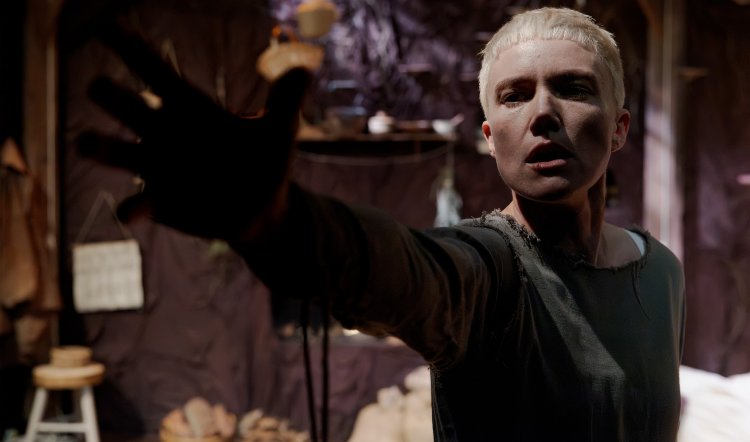
To Emma Wright, however, the crucial fact of the mainly nonsensical plot of A Winter’s Tale is that Hermione disappears from the action – and from Shakespeare’s mind – for 16 (sixteen!) years. And, as becomes clear in the play’s 100 minutes, she’s not the only one to suffer the slings and arrows of outrageous fortune (from Hamlet, see above, and not quoted in Harlots).
In Harlots, therefore, Paulina (Hannah Waterman), one of the noblewomen of Leontes’ court, has founded a women’s refuge for these forsaken women, and that is where we find ourselves – hidden beneath a great tree, whose roots embrace a spacious cavern where rugs, cushions, lamps and a constantly-replenished teapot make it welcoming and safe, and scented by earth and the platelets of white bracket fungi that decorate the walls. (Actually, there is no smell, but Kate Beere’s set design is so vivid, along with the beautifully calibrated chiaroscuro lighting (Luna Yuet Yee Ng), cleverly apt sound (Clare Hennessy), and Elizabethan-esque costumes (Aloma Barnes Siraswar), it’s hard to believe we’re not deep in it with the women.)
The thing about Harlots is that, as is the case with most women, they’re all too aware of what’s going on above with their ordinarily and traditionally tyrannical, jealous, murderous, arrogant, silly men. The essential matriarch Paulina dispenses tea (unusual variety), sympathy and wisdom, while refugees come and go to variously tragic or hopeful futures.
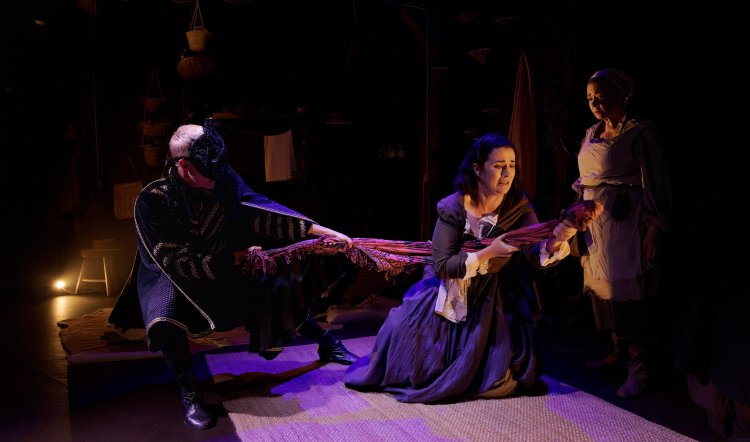
Ophelia ('Ana Ika) is, as in the canon, beyond help and remains a sad, ghostly figure. However, Wright’s imagination and bold approach to the women give new life and poignancy to Helena (Ella Prince), who still loved and hung out for Demetrius despite his faithless nincompoopery in A Midsummer Night’s Dream. And Beatrice and Hero (Jo Downing and Madeline Li), the loving cousins of Much Ado About Nothing, whose torturous lives at the hands of father/uncle and suitors are enough to make pots of Paulina’s “tea” a must.
Director Janine Watson orchestrates an often stark picture of these women and the fates they endure or conquer in their subterranean world with its pertinent sense of danger. There’s not a weak link in the company with Waterman, Prince and O’Connell to the fore.
Harlots is a remarkable new play, a work of imagination, scholarship and drama. A virtually seamless structure of apposite Shakespearean fragments signposts the origins of these new lives as conjured by Wright. It’s moving, eye-opening, thought-provoking, occasionally funny and constantly heart-stirring. Youngsters of all genders need to see it (15-up) – and oldies too – not to be missed.
Comments
Leave a Comment
Enter your username and password to comment. Don't have a username? Register now.
Be the first to leave a comment below