TURANDOT

TURANDOT, Opera Australia at the Joan Sutherland Opera Theatre, Sydney Opera House, 15 January-27 March 2026.Photography: Keith Saunders
In her program notes, director/choreographer Ann Yee writes, “When I watch the chorus, the dancers, and the singers work their magic throughout this production, I am reminded every minute and every day how we are part of a whole, and when we recognise that, we soar.”
On opening night, over its two and a half hours of magic, that recognition percolated through to the audience so that, by the time the Chorus’s final notes floated across the footlights, the spontaneous rise to a heartfelt standing ovation was swift. It was the culmination of an almost flawless evening of luscious music and unusual spectacle, and the communal thrill was palpable.
Turandot is one of the most popular yet problematic of the classic romantic operas. Its popularity lies in Puccini’s breathtaking music, from its cunningly introduced and sustained motifs, to the ultimate spine-tingler “Nessun Dorma”, via some of the more beautiful duets, comical trios and thrilling chorus works ever written.
The problematic aspect of Turandot, for a 21st century audience, lies in its cack-handed Orientalism. It’s simply not done these days to hijack aspects of another culture and make free with them. However, the composer and his librettists Giuseppe Adami and Renato Simoni came up with such a bizarre mishmash of possible sources (ancient Persia, old Russia and lots of dubious Chinese) as to render irrelevant their ideas of the Exotic East.
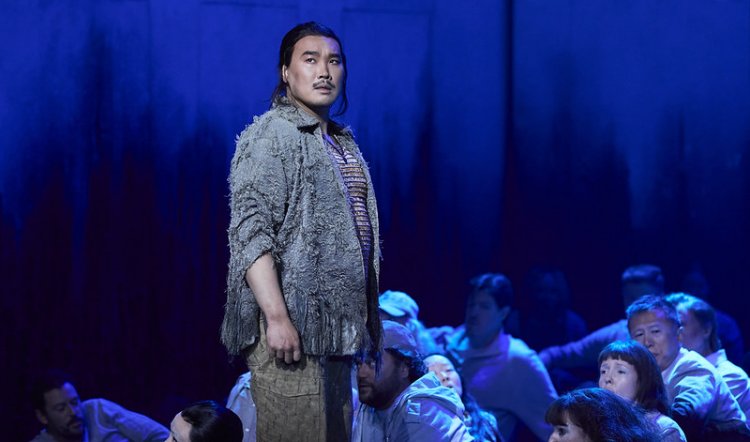
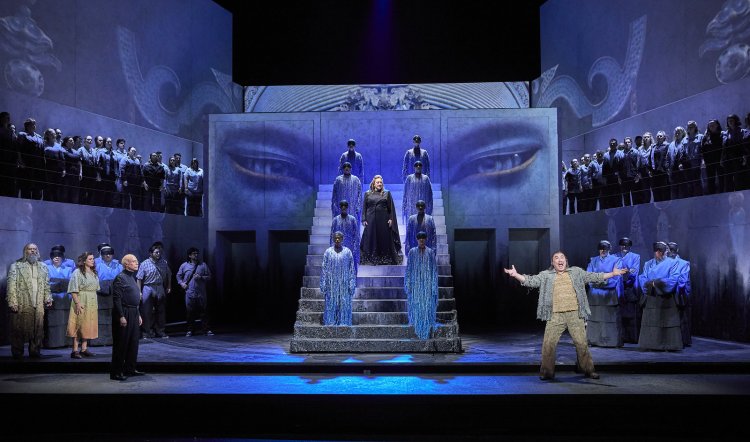
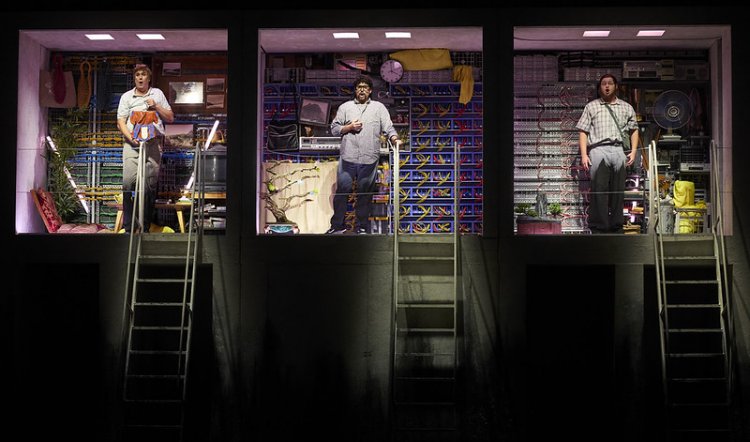
Director Yee has taken a cue from that and gone deep beneath the surface to the emotional truths embodied in the characters, and with set designer Elizabeth Gadsby and costume designer David Fleischer, has neutralised those quaint distractions. The colour palette is granite grey structures, and simple two-toned charcoal work clothes for the Chorus. Occasional washes of red and stark white dazzlement (lighting Paul Jackson) are like reminders of another world, while the cornflower blue outfits of court attendants and the ancestral spirit (Hoyori Maruo), who opens the night in a silent acrobatic dance sequence, all lead away from the usual cliches of bygone China. The princess Turandot is clad in semi-regal glittery black, while her suitor Calaf is roughly dressed as befits a prince who’s been wandering the wilds for a bit. The servant Liù wears sensible shoes, a dowdy blouse, and skirt, while the trio of Ping, Pang and Pong are obviously tech nerds.
The unlikeliness of the scene – accustomed as we are to the hanfu, shenyi or cheongsam – is then stood on its head by video projections of an avatar (design Andrew Thomson Huang) that interacts through spooky eyes with the action.
Nevertheless, Turandot is all about the music, and this production celebrates it in buckets. Under the baton of Henrik Nánási, the always reliable OA Orchestra is in powerhouse mode, while the Chorus thrillingly sets the pace and tone in the first act, and the Children’s Chorus is enchanting.
Dramatic soprano Rebecca Nash is back at OA after a 25-year absence (what!) and is a splendid principessa whose damaged soul and hardened heart are finally restored by the combination of Maria Teresa Leva’s sensitively exquisite Liù. Individually and together, these two light up the Joan Sutherland stage.
Then there’s the outstanding Young Woo Kim as Calaf – he who must be named or else, as decreed in one of the regal riddles. Mr Young is a physically and vocally powerful tenor and is a joy to hear and watch. So much so that the one misstep in the production is to disallow the audience to respond after he delivers a nuanced but impassioned “Nessun Dorma”. It might not be correct to applaud at the end of an aria, but in this instance, the subsequent entrance of Ps 1, 2 and 3 caused a noticeable hiccup as applause faltered and died.
As Ping, Pang and Pong, Luke Gabbedy, John Longmuir and Michael Petruccelli are both comical and credible, while Richard Anderson’s Timur has all the gravitas and humanity needed in the father figure role. The bespectacled emperor (Gregory Brown) and Speaker Shane Lowrencev round out a fine company. On the night, a riveting and thought-provoking production was crowned by such a sustained display of vocal fireworks as to keep most audients up for a few hours at least on an adrenaline high. Second triumph in a row for OA in 2026.