
THE BIRDS


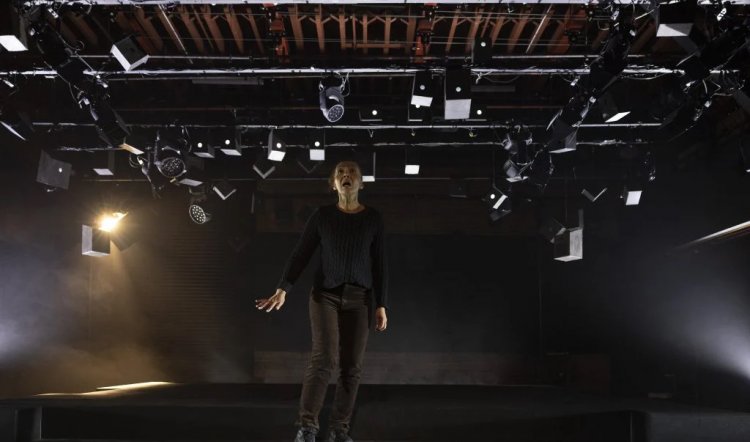
THE BIRDS, Malthouse Theatre at Belvoir St Theatre, 16 May-7 June 2026. Photography by Pia Johnson
Belvoir’s audience these days is thought to be a fragile mob of snowflakes, with those attending The Birds warned: “This production contains coarse language, graphic descriptions of violence, harm and death. Loud and sudden noises, flashing lights and smoke effects are also present.”
Although that list sounds like a regular night at home watching Netflix, the odd thing is what it doesn’t include: any caution for ornithophobes. Ornithophobia is defined as an extreme and irrational fear of birds, although those who describe being dive-bombed by a furious magpie would argue the irrational bit.
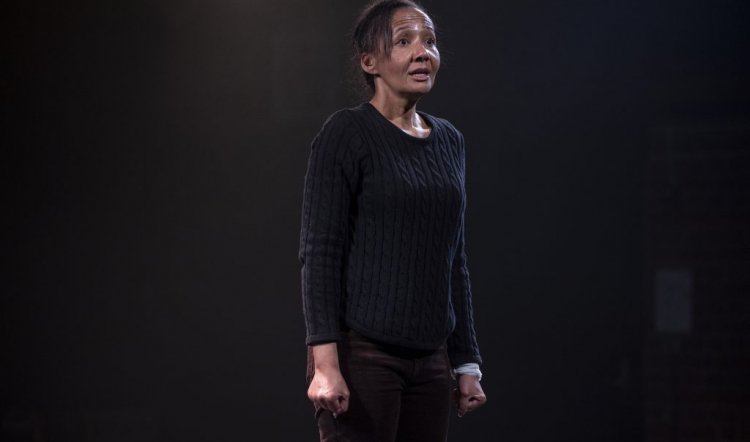
The thing about Louise Fox’s adaptation of Daphne du Maurier’s short story (made infamously terrifying by the Alfred Hitchcock film) is that “coarse language” etc., etc., blah blah blah, are as nought in the face of Paula Arundell’s profound, sinewy portrayal of a mother in extremis. Never mind that she also conjures up her two kids, husband and other elements of an oceanside Aussie village – all brought to life in a transfixing 80-minute performance.
Like so much of du Maurier’s work, The Birds is a wicked jolt to gentle sensibilities. Published in The Guardian in 2007 (celebrating the centenary of the author’s birth), Kate Kellaway wrote: “Du Maurier was mistress of calculated irresolution. She did not want to put her readers' minds at rest. She wanted her riddles to persist. She wanted the novels to continue to haunt us beyond their endings.”
That is the perfect description of du Maurier at her best, and also the effect of her 1952 short story The Birds. Like many millions, especially Brits, du Maurier’s younger life was overshadowed by WW2 and the uncertain years leading to its outbreak. The massed gulls and starlings of the story’s title are a powerful metaphor for what happened in Europe, then around the world. The growing menace of their gatherings, their increasingly overt hostility and eventual deadly violence are as unnerving as could be imagined without actually dressing the little feathered fuckers in Wehrmacht uniforms.
Although Trump’s catastrophic antics of 2026 weren’t even a stye in the eye of the farsighted in 2024 when Fox and director Matthew Lutton conceived the adaptation, the parallels – same same but different – are obvious. Who could blame birds or any other living creature for feeling murderous towards humans? We are destroying their habitats and futures on a scale and speed never known before.
Arundell’s protagonist, Tessa, has moved to her Australian townlet to escape the city’s pollution, but you can be sure surrounding farms are awash with pesticides and so-called fertilisers. The beach she loves must be augmented by an uncountable amount of microplastics, while her family is probably ingesting 240,000 particles per litre in their bottled drinking water. And any minute, her patch of ocean will be spewing Karenia algae and dead sea life. Happy days.
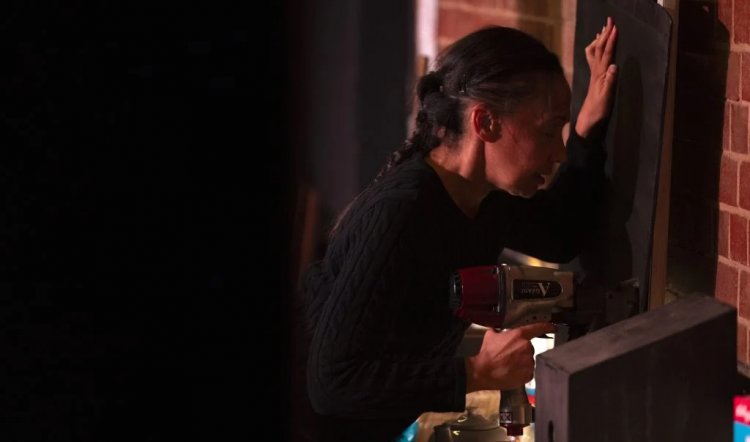
Meanwhile, back at Belvoir, these potential and likely horrors are for later consideration as one’s insides contract with anticipation and fright. All caused, not by graphic depictions of the above barbarism, but by sound and light and performance. Arundell is ostensibly alone on stage, but is actually playing in close and seamless harmony with lighting (Niklas Pajanti), sound and music (J David Franzke), and setting (Kat Chan). Although she is telling us a gripping story, there is also plenty of action with a treadmill in place of a more conventional revolve. At the same time, the minimal dark sketch of habitation leaves a good amount to the imagination.
The Birds is clearly an intelligent and beautifully developed team effort from Lutton & Co, but it’s Paula Arundell whose life is on the line each night, and she is mesmerising. She goes from puzzled, to irritated, to vulnerable and frightened, to defiantly, indomitably powerful. There’s not a hint of melodrama, so the phantasmagorical central premise becomes all too likely in this time of the unbelievable and the unimaginable. Set aside the movie and the short story: this is the real thing all of its own.
Comments
Leave a Comment
Enter your username and password to comment. Don't have a username? Register now.
Be the first to leave a comment below