BETRAYAL


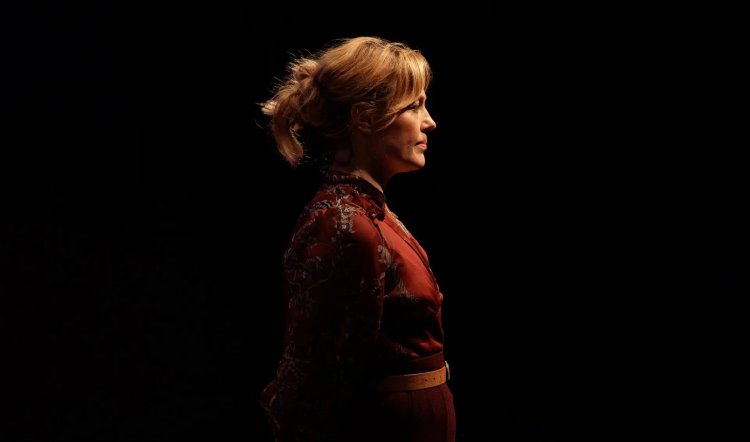
BETRAYAL, Sport for Jove at the Old Fitz, 15 July to 10 August 2025. Photography by Kate Williams
What’s lost to time and short memory now is that Harold Pinter’s 1978 play was known to be autobiographical, recounting his long, secret affair with TV current affairs star Joan Bakewell. The equivalent for us would be discovering something similar about Sarah Ferguson – shocking, much? And, for those in the know, that’s how it was when Betrayal was first staged. By which time, Pinter had moved on from Bakewell to Lady Antonia Fraser, where he remained until death did them part in 2008 (Fraser is now 92).
Pinter’s second surprise for his audience was the then novel approach of playing the narrative in reverse: Emma (Ella Scott-Lynch) and Jerry (Matt Hardie) meet for a drink two years after the end of their seven-year romance. From there, each scene ratchets back a couple of years to the night when a tipsy Jerry makes the pass that will begin the affair with best friend Robert’s wife.
Jerry is a literary agent with a famous nose for new literary talent, and Robert (Andrew Cutcliffe) is the successful publisher of fiction. Unknown to both men, Emma is currently involved with Casey, a novelist discovered by Jerry. As the reverse narrative unravels, like film off a spool, director Cristabel Sved maintains a steady and illuminating pace. The tangle of many and various lies, duplicities and secrets could be confusing, but is effortlessly disclosed through Pinter’s uniquely spare yet unerring dialogue, and splendid work from the three actors.
Betrayal depicts the foibles of the human heart as universal, yet there’s nothing new under the sun. Think only of the global frisson over 15 seconds of ColdPlay-Cam – generating memes and millions of sniggers around the world at suddenly exposed extra-maritals. What says 1978 about Pinter’s play-affair, however, is that the clandestine lovers could easily rent and afford a flat in Kilburn, which meant they wouldn’t bump into fashionable friends or literary types – and keep it for afternoon trysts.
The other era-sensitive element of the play is the letters written, and in the case of one sent by Jerry to Emma in Venice, intercepted by Robert. At the same time, though, is it much different from the “ping” on a phone that reveals a DM, or an email carelessly left accessible on a laptop?
Whichever way you look at the idea of betrayal, it’s most people’s least favourite thing to inflict or to suffer. Although comically, Jerry is especially upset when Emma confesses that she’s told Robert about their affair without letting Jerry know first! Given the title and subject matter, one could imagine being in for 90 minutes of angst and heartbreak, but in the subtleties of the script and the playing of it, there are many sly laughs. Sometimes so unexpected that the laugh comes a few seconds later.
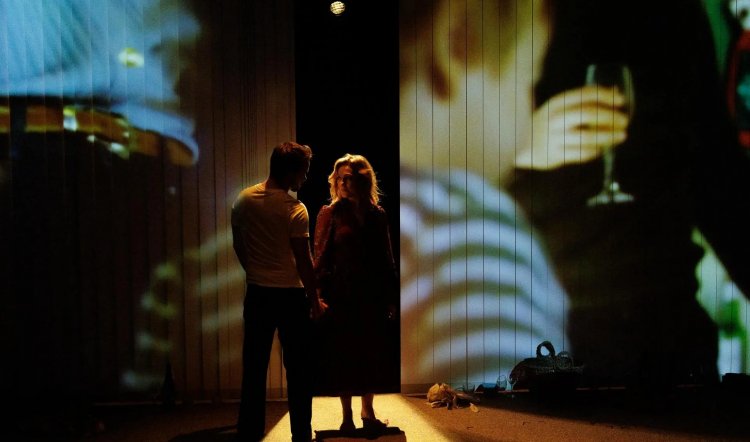
The production is also clever in the way it’s presented: the stage is bare but for two chairs. Change is minimal and made through the opening, closing and shifting back and forth of a wall of pale vertical blinds. Occasional projections on the closed slats sketch in an incident or moment in time; otherwise, it’s the actors and the many drinks they share – with the glasses left on the floor in multiples of beer and wine – and locations indicated through muted lighting states. (Design: Melanie Liertz, co-lighting design: Verity Hampson and Luna Ng.)
Composer Steve Toulmin and sound designer Johnny Yang contribute colour and mood through pre-show music of some of the more sinister tracks from suave creepsters such as Sting and Bryan Ferry, as well as silky solo piano fragments as time goes by (and backwards). All serve to point to the unreliability of human beings.
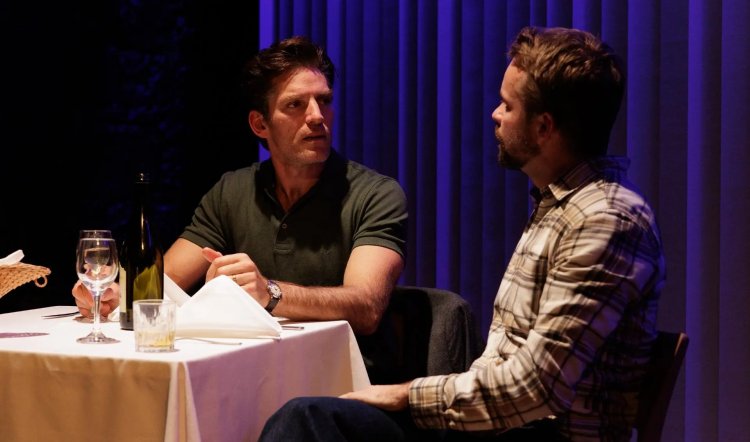
The night belongs to the actors, however. Ella Scott Lynch is a moving, riveting presence throughout, while Andrew Cutcliffe generates unease to make one continually glance in his direction. And Matt Hardie takes on the unlikely combination of lover, cuckolder and cuckold’s best friend with credible charm. Finally, the brief cameo by Diego Retamales as a waiter from the Fawlty Towers school of flubbing is well worth his time and audience chuckles.
All in all, Betrayal remains a fascinating portrait of middle-class conventions and their emotional underbelly, whether you know the actual protagonists or not. A very fine production of a close to 50-year-old classic. See it.